Bones, Seeds, and Shell: Studying Faunal and Floral Remains

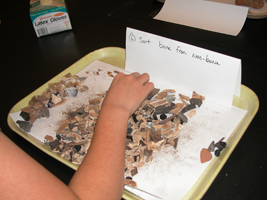
Various fragments of bone and shell
Can you tell what materials in this assemblage represent bone?

Hi! My name is Jessica Yuan, and I’m a sophomore who is about to declare a major in Cultural and Social Anthropology. After taking an introductory course to archaeology last quarter, I was itching to put my new theoretical knowledge on archeological concepts and techniques to use. When the opportunity to enroll in Professor Voss’ class on laboratory methodology in archaeology arose, I signed up eagerly, knowing it would be the perfect venue for me to explore my interest in archaeology further and gain substantial hands-on experience in analyzing historical artifacts. I have gotten much more than I bargained for: in addition to acquiring skills in the identification, analysis, and cataloging of a wide array of materials, ranging from ceramics to lithics, I have also learned much on the history of overseas Chinese in the San Jose area. As my own family’s legacy is one of immigration from China to California, I found much of the contextual information of the Market Street Artifact Collection especially relevant to my understanding of my own family heritage.

Bear inspecting botanical specimens through a microscope.

This past week marked the eighth that our class has spent with the Market Street Chinatown Artifact Collection, and we are becoming more and more adept at classifying different archaeological materials. Our focus this week has been on recognizing faunal and floral remains and drawing various analyses and interpretations from them. As a class, we got an opportunity to try our hand at zooarchaeology, learning some of the fundamentals of skeletal anatomy and bone structure, in addition to different methods of collecting descriptive, primary data and interpretive, secondary data. We learned how through studying weathering and abrasion patterns or calculating MNI (Minimum Number of Individuals) values, archaeologists can make inferences about ages, genders, and frequencies of various animals, which allow for interpretations into patterns of culture and activity of the past. Following a lecture on Tuesday, the class spent Thursday in a practicum setting, examining botanical and faunal materials. By studying seeds and various fragments of bone and shell, we were able to gain some insight into the lifeways of people of the past. Friday was open lab day, in which students each worked on the individual research projects they have been developing throughout the quarter, which address topics as diverse as hygiene practices, conceptions of childhood, and household religious activity in the Market Street Chinatown.


Featured Artifact
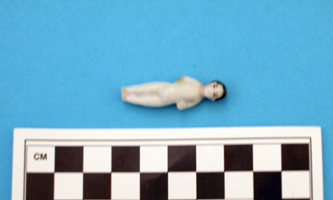
Frozen Charlotte doll, less than 4 cm long.
This Frozen Charlotte doll is less than 4 cm long.

With its delicately painted pink cheeks and black hair, this Frozen Charlotte doll that Rachel discovered when searching through a storage box immediately caught my attention. Measuring only 3.73 cm in length, this porcelain doll was one of many mass-produced in Germany between 1860 and 1900. These tiny dolls, which typically ranged in length from one to four inches, were widely popular throughout the United States in the late 19th and early 20th centuries, perhaps because as “penny dolls,” their low price made them well-suited for children’s toy collections. The doll was named after the title character in the William Lorenzo Carter folk ballad “Fair Charlotte,” which sings the tragic story of a beautiful young bride who freezes to death on a winter sleigh ride with her husband after refusing to warm herself with a blanket. The presence of these Frozen Charlottes in the Market Street Chinatown attests not only to the presence of children within the community, but also to a degree of acculturation to Western practices and adoption of Western commodities.

And the Search Begins…

Lab Time: Bear examines buttons (right), while Rachel, Stephanie and I study stone tools (left)

Welcome, dear readers, my name is Megan Kane. I am a senior/master’s student in the Archaeology Center at Stanford. Having studied primarily prehistory for the last three and a half years, I thought it would be very interesting to learn about more historical archaeology, so I find myself taking CASA 203. I must confess that I never cease to be amazed by the level of detail that historical archaeologists can achieve in their studies. The kind of resolution we prehistorians rarely even dream of! Outside of my growing jealousy, I am learning a great deal about the process of cataloging and analyzing artifacts in the lab. Our time in the lab this week was split between two tasks: learning about lithics and small finds and searching for the artifacts that we will be working with in our projects. The topic of “Lithics and Small Finds” is a very broad one, and I found myself examining everything from prehistoric grinding stones, or manos, to opium pipe bowls. During lecture we discussed the various techniques employed in stone tool production, various striking methods for flaked lithics and how to identify production steps, later putting all of this to practice in the lab. The category of small finds includes many personal objects, like buttons, beads, pipes, etc. Having worked with period and vintage costuming in the past, I was particularly struck by the buttons we examined in the lab. It is amazing that, as an archaeologist, I can hold in my hand a small and a very personal part of someone’s life, like a shirt button or a pipe.

Anglo-American tobacco pipes and Chinese opium pipes from our lab session

During the lab session on Friday, all of us began the mad scramble to find the artifacts that we will study in our research projects about the Market Street Chinatown. The lab table was quickly swamped as we searched catalogs, excavation reports and boxes for everything from toothbrushes and dolls to storage jars and glass bottles! My own research is focused on household and small scale religious practices in the Chinatown, a scarcely studied topic, and I am quickly discovering why this topic has rarely been touched on in previous studies of overseas Chinese communities! The types of religious practices performed in homes most likely included the burning of incense and food offerings to the gods and ghosts, activities which are either invisible archaeologically or indistinguishable from more secular activities. So it has been very hard to identify a class of objects in the Chinatown collection that might be associated with such practices. But I have stumbled upon several examples of oil lamps and candleholders, which might have been used during such household rituals. Now comes the arduous task of finding all the examples of these artifacts in the dozens and dozens of boxes and analyzing them!


Featured Artifact

Lyon's Kathairon hair tonic bottle, embossed “For The Hair”
Lyon’s Kathairon hair tonic bottle, embossed “For The Hair”

This week’s artifact of the week is a small glass bottle that Stephanie is analyzing for her project. The bottle is aqua tinted glass, about 16.5 cm tall, embossed with “Lyon’s / Kathairon / For the Hair / New York.” The bottle is perfectly intact with a none too subtle proclamation of its original contents, a hair tonic. According to a period advertisement (see image), Lyon’s Kathairon was meant do just about everything, to cure baldness, to curl hair, to calm the scalp, and to reduce dandruff! This little bottle is a window not only into hair care and personal hygiene in the Market Street Chinatown, it might also reveal information about the ideals of personal appearance and the use of Anglo products by the Chinese overseas community.

Trade card advertisement for Lyon's Kathairon Image found at http://www.rubylane.com/ni/shops/kitbarry/iteml/0649#pic1
Trade card advertisement for Lyon’s Kathairon Image found at http://www.rubylane.com/ni/shops/kitbarry/iteml/0649#pic1

Metals and More

Rachel checking for manufacturer's marks.
Rachel checking for manufacturer’s marks.

Hello, my name is Rachel, and I am a graduate student in the Department of Cultural and Social Anthropology. I decided to take CASA 203 Lab Methods class, as coming from a different disciplinary background, the class offers the learning of skills I need to acquire! Although my research is in Ghana, West Africa, I view these techniques and methods as highly transferable. I have thoroughly enjoyed working with these artifacts – the tangible nature of these objects brings history alive. I am very grateful to the Chinese Historical and Cultural Project and the community for allowing me to participate in this fascinating project. Thank you.

Megan and Jessica cataloging.

This week we turned from glass analysis to metals. Metals are interesting since depending on their composition they change in appearance with time: copper and copper alloys develop a green patina, silver and pewter turns black or dark grey, iron and iron alloys develop a red corrosion, and white metals (lead, tin, aluminum and zinc) develop a white or grey patina. We didn’t examine gold, but this does not corrode. Some of the objects we examined were: jewelry, bolts, nails (and more nails!), a pencil top, buttons, a suspender holder and what I thought looked like a door handle! On Friday, we worked on our own individual research projects in which we analyze objects from the collection. To that end, I went with Bryn to the storage to look for something to research. Wow! So many boxes! I was thrilled to find – in the first box I examined – a watch and some pieces of broken dolls. I also discovered a minature doll, that Professor Voss tells me is called a ‘Frozen Charlotte’. Well, it was a tough decision between the watch and the dolls, but the latter won! I am really looking forward to learning more about children and childhood in Market Street Chinatown.


Featured Artifact

Featured Artifact: A prosser button fragment.

The artifact of the week is my unexpected discovery – a Prosser button. I thought this was rather exciting since it was inside the base fragment of a green bottle probably used to hold alcohol. The button was not catalogued which meant that we had to create a record for it. White in color, with a glassy appearance, in actuality, it was only half of a button, yet one can see a distinct design around the edges. Made of high fired clays, these buttons were manufactured in several styles between 1850 and 1920. Although small in size, buttons are interesting and can tell us a lot about the past; they are good indicators of gender, economic status and activities of a site’s occupants.