Cataloging Update from Jessica Yuan

Remains from two glass egg cups engraved with stars

Things have seemed fairly quiet in the lab this spring and summer; now that the course CASA 103/203 has come to an end and the lab is no longer filled with students anxiously scrambling through boxes of artifacts to find materials to analyze for their projects. Throughout Spring Quarter, I have worked as a research assistant in the lab, helping Bryn out with the project he is working on for his dissertation; this has mostly entailed additional artifact cataloging and analysis. While I have come across beads, buttons, and other small finds, my efforts have primarily been devoted to glass analysis. I have worked with a wide range of glass materials, ranging from glass tumblers to window glass sherds, but most of the identifiable glass I have catalogued seems to have come from bottles of some sort. In particular, I have found many fragments from alcoholic-beverage bottles, and even a few bottles that are almost entirely intact. To the best of my ability, I have attempted to identify the origins and contents of these bottles. I plan on spending even more time with such vessels in the upcoming weeks, as I assist Professor Voss in conducting research for her project on alcohol consumption practices at the Market Street site. Among the most interesting finds I have come across in my cataloging are fragments from two tiny glass cups, which appear to have been egg cups. One of the cups is nearly complete, and both cups are made of transparent glass and bear the same pattern of engraved stars. They seem to match each other and might have come from a set. Does anyone know anything more about these cups?

The intact base of the wine bottle from which the Pernod Couvet maker’s mark came

This wine bottle was another particularly striking find. Although it is highly fragmented, most of its pieces were successfully recovered. One of its 21 fragments bears a maker’s mark that reads “ED. PERNOD COUVET.” Upon hunting around for the origins of this mark, I discovered that it was probably the mark of the Pernod Fils Factory that operated in Couvet, Switzerland in the 19th century. The Pernod family was especially known for absinthe production and ran factories in both Switzerland and France. Edouard Pernod was the eldest son in the family and took over the Couvet factory in 1827, transferring it to his own name.


Featured Artifact

The maker’s mark reads “ED. PERNOD COUVET” and bears a symbol of the Swiss cross

This artifact is especially significant as it might elucidate details on trade networks and economic patterns in the Market Street site: was wine a commodity that was imported from European manufacturers in bulk to merchants and stores internal to the site? Or, conversely, was this one bottle a rarity that represented a gift or purchase from an outside supplier? It will be interesting to see if more bottles with maker’s marks associated with the same manufacturer turn up.
Student Research Projects 2006-2007

Photography

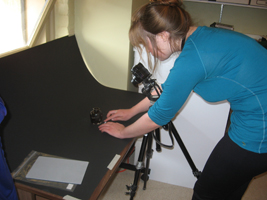
Rachel tries out different lighting for her shot.

Hi! My name is Madeleine “Bear” Douglas, and I am a second-year undergraduate student here at Stanford University double majoring in Archaeology and Economics. I decided to take this class because although I am an archaeology major, until now I had no practical experience with analyzing a collection. I thought I could learn a lot from a lab class in preparation for my studies later on and for this summer, when I will be on a dig in Çatalhöyük, Turkey. It has been a privilege to work with the materials from the San José Market Street Collection, and I hope that my project, on oral hygiene and toothbrush technology in the Market Street Chinatown, will be of interest and maybe of use to some of you.

Jocelyn adjusts the scale in her photograph.

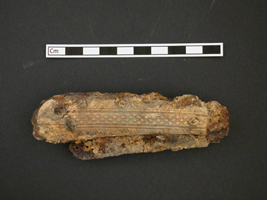
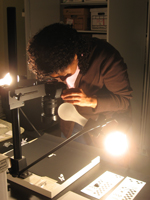
Now that the quarter is coming to an end, everyone in the class is logging extra hours in the lab, pulling out and cataloging artifacts relevant to their projects, taking measurements, and checking historical references. As part of our projects, each of us will be making a presentation to the class on our research and our findings. To help us make more effective presentations, and also to teach us an important part of data management in archaeology, this week we learned about archaeological photography. Our guest lecturer, Jason Quinlan, taught us all a great deal about what goes into taking a good artifact photograph. First, you have to choose what aspect of the artifact you want to come through in the photograph: what is interesting or special about it? For example, if you want to emphasize the texture on an object, or some sort of engraving on its surface, using oblique lighting to cast a slight shadow will help that texture come out. If the object is smooth, you may not want to create those shadows. One of the most important things about archaeological photographs is scale. In every photograph, it is important to include a scale (a piece of paper or wood with length markings) in order to show the artifact’s size. Otherwise, it would be easy to think a huge urn could fit in the palm of your hand! We experimented in lab with photographing some of our artifacts, altering the aperture and shutter speed on the cameras to see the different effects of the change in lighting. This week’s artifact of the week served as our guinea pig- you can see the result below.


Featured Artifact

An ivory handled jackknife- buried treasure!

I found this week’s featured artifact bagged up in a box with some other small bone finds while I was searching for toothbrushes to analyze for my project. It is an ivory handled jackknife about 10 cm long with a blade that corroded while partially unfolded. The handle is engraved on both sides with a raised diamond pattern in the center and crosswise marks on the side. I was struck by the quality of the craftsmanship on the handle and by how well preserved it was. A knife like this would have been very expensive, and was probably a prized possession of the person who lost it.