Visiting the Market Street Chinatown and History San Jose

Visiting the site of the Market Street Chinatown.

On February 1st, our class visited San Jose. Our first stop was the Fairmont Hotel downtown. The Market Street Chinatown covered multiple blocks downtown, but the part of the collection we are currently working with in this class came from the block where the Fairmont Hotel stands today. At the site we saw two signs marking the former site of the Market Street Chinatown and the fire that destroyed it. Walking around the hotel, we were excited to see how much of the plan of the Chinatown still exists at the site: several of the surrounding streets retain their original names, and with the help of a nineteenth-century insurance map we were able to begin to envision the layout of the Market Street Chinatown. Our visit also impressed upon us how central the Market Street Chinatown’s location was in nineteenth-century San Jose. This was not a hidden community, but was in the middle of the city.

The reconstructed Ng Shing Gung temple from Heinlenville, located in the History Park.

We next visited History San Jose, where Sarah Pluckitt and Paula Jabloner led us on a tour of the facility. We saw the collections storage units where this collection will ultimately be curated. Once the Market Street Chinatown archaeological collection is fully cataloged, it will join History San Jose’s extensive collections documenting the history of the Santa Clara Valley, and will be available for researchers to study. After touring these facilities, we met Anita Kwock and Lillian Gong-Guy of the Chinese Historical and Cultural Project at the Ng Shing Gung temple museum in the History Park of San Jose. They kindly took the time on the first day of the Chinese New Year to guide us through the exhibits at the museum, and also answered some questions we had about the history of San Jose’s Chinese community. These experiences really helped to bring the collection to life! After experiencing so much hospitality, we are happy to welcome visitors to our open house on February 8th!

Artifact of the Week

Medicinal bottles 85-31/2-34, 85-31/2-33, and 85-31/33-11.

This week our classroom instruction focused on the processing of glass artifacts. The study of glass can often yield a great deal of information about consumption and economic activities. Because it is often broken or discarded after its contents are used, glass is often quite useful in determining the date of an archaeological deposit. Among the glass artifacts from the Market Street Chinatown collection are several medicinal bottles and vials, such as those shown here. The smaller vials are often found associated with overseas Chinese sites, and contained a variety of medicinal compounds. According to its embossed label, the larger bottle in this picture contained medicines from a local San Jose druggist named R. E. Collins. The presence of both types of bottles in this collection are another indication of the way that life in the Market Street Chinatown incorporated both traditional Chinese practices and also practices of the larger San Jose community.

Putting Things into Context

Connie Young Yu with the students from the laboratory methods class, after her talk on January 28.

Gung Hay Fat Choy! Happy Chinese New Year! This week was a special week for our project. On Tuesday, Connie Young Yu, historian and author of the book, Chinatown, San Jose, U.S.A., guest lectured in our Tuesday morning class. Connie Young Yu’s exhaustive documentary research into the history of Chinese Overseas communities in the Santa Clara Valley is augmented by personal interviews and family history. Her grandfather, Young Soong Quong, was a pioneer of San Jose’s Market Street Chinatown. He arrived at the Market Street Chinatown in 1881 at age 11 to work as a child laborer, first in a store and then as a house servant. Connie’s stories about her family and their acquaintances at the Market Street Chinatown put a human face on the artifacts that we are cataloging, and helped us better understand the community’s vibrant social life.

Materials used in cataloging: catalog record forms, archival polyethylene bags, liquid lacquer for labels, and marking pens and pencils.

In the discussion forum of this website, one message posted on January 14 asked, “what will be done with the artifacts once cataloged? With about 500 boxes this could take awhile.” This is a great question. We’re still not sure how long it is going to take to catalog the entire collection, so we are working through the collection in small batches. As artifacts are cataloged, we will have the collection inspected by a professional conservator to identify which artifacts might need special treatment to prevent deterioration. We also hope to develop a digital visual archive of the artifacts, which would put both the catalog database and pictures of the artifacts on a website. The artifacts themselves will be returned to History San Jose where they will be available to researchers and educators, and can be used in museum displays. We envision that the first group of artifacts might be returned to History San Jose before the end of the year.

Artifact of the Week

Bracelet fragments (from left): 85-31/3-6, 85-31/7-1, 85-31/13-301, 85-31/18-28.

Gina cataloged these jade and imitation jade bracelet fragments last week. The imitation jade bracelets are manufactured from green-tinted glass, but over the years a light patina has altered the color of the glass surface. The only artifact that is true jade is the one on the far right. In a discussion comment posted earlier, Gina commented, “What is really interesting to me is that both jade and glass bracelets were found on the same site. I wonder what that might say about differences in class, or maybe everyday vs. special occasion jewelry. If anybody has any ideas I’d love to hear them.”

Now what do we have here?

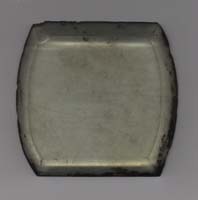
Beveled leaded glass, catalog # 85-31/35-24.

It’s not uncommon for archaeologists to find objects that baffle them. This week our project update provides images of two such artifacts that we have come across during our cataloging of the Market Street collection, which we either haven’t been able to fully identify or that were tricky at first. We are hoping that you might be able to help us by sharing your knowledge with us about these pieces! This first artifact is a flat, beveled piece of leaded glass. It is roughly square in shape, with two parallel sides, and two sides that bow outwards. There is a residue adhering to the outer edges of the object both on the beveled surface and on the underside. The residue is greenish-brown and compares favorably in color to a copper alloy, perhaps suggesting that this piece of glass was originally mounted in a metal casing. The artifact measures 85mm x 80mm x 9mm.

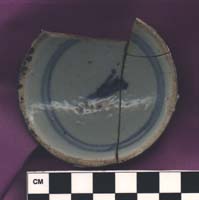
Lamp, catalog #85-31/13-158.

An artifact that took some time to identify is this porcelain dish. Decorations on the dish were hand-painted in blue underneath the glaze. The pattern consists of two concentric circles around the rim and an unidentified image in the central medallion. The underside is unglazed. A similar artifact found at the Riverside Chinatown was classified as “Southeast Asian Porcelain,” a term which refers to Chinese-produced ceramics found commonly at archaeological sites in Southeast Asia. Looking at the size, shape, and fabric of this vessel, it resembles a small condiment dish. The vessel also has a black residue on part of its rim. But what is it? This is where comparative collections, reference books, and the work of other archaeologists and historians really help! By consulting the report of excavations of a Los Angeles Chinatown occupied in an overlapping time period, we found that dishes like this one were often used as small lamps. Peanut oil or animal fat was poured into the dish, and then a wick was put in and ignited. Roberta Greenwood, the author of this book, also found blackened, burnt residue on similar artifacts from her work in Los Angeles.

Artifact of the Week

Toothbrush, catalog #85-31/28-11.

Since we presented two artifacts that were (and are!) difficult to identify, our artifact of the week is one that is fairly easy to recognize. This is a toothbrush, made out of bone. The “head” of the toothbrush contained several long rows of bristles. Although these toothbrushes are not very different in overall design from other toothbrushes of the nineteenth century, or from modern toothbrushes for that matter, they are recognizable as Asian toothbrushes due to a very distinctive trait. The holes for the bristle go all the way through the toothbrush, while European and Euro-American toothbrushes of the time did not have holes for bristles that penetrated all the way through the handle. The design of the Asian toothbrush allowed the bristles to be replaced. Bristles would be inserted from the front of the toothbrush, then bent and inserted through the back. The bristles would then be cut to create a “brushing” surface. That these brushes were used for quite some time is attested by the degree to which their handles have been worn over time.